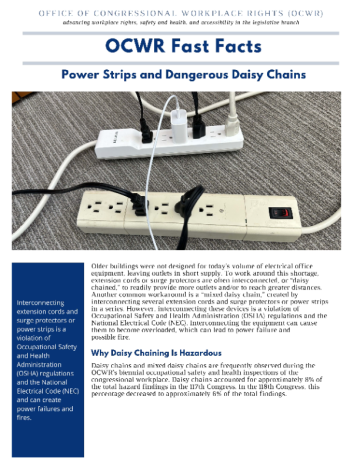
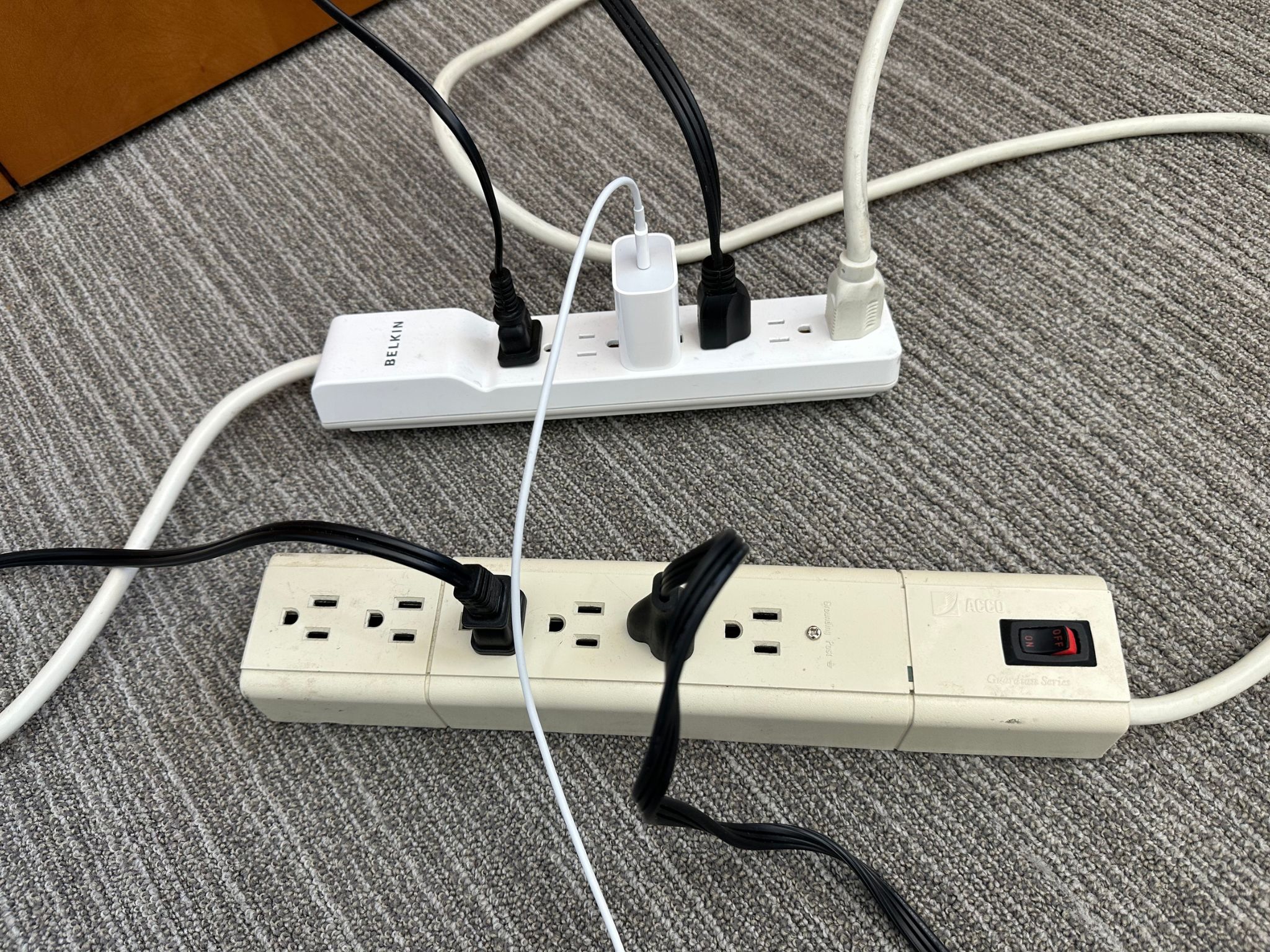
Older buildings were not designed for today’s volume of electrical office equipment, leaving outlets in short supply. To work around this shortage, extension cords or surge protectors are often interconnected, or “daisy chained,” to readily provide more outlets and/or to reach greater distances. Another common workaround is a “mixed daisy chain,” created by interconnecting several extension cords and surge protectors or power strips in a series. However, interconnecting these devices is a violation of
Occupational Safety and Health Administration (OSHA) regulations and the National Electrical Code (NEC). Interconnecting the equipment can cause them to become overloaded, which can lead to power failure and possible fire.
Why Daisy Chaining Is Hazardous
Daisy chains and mixed daisy chains are frequently observed during the OCWR’s biennial occupational safety and health inspections of the congressional workplace. Daisy chains accounted for approximately 8% of the total hazard findings in the 117th Congress. In the 118th Congress, this percentage decreased to approximately 6% of the total findings.
OSHA regulations require that conductors and electrical equipment be used in accordance with the conditions under which they are approved by a recognized testing organization (29 CFR 1910.303(a)). Most power strips or surge protectors are approved for providing power to a maximum of four or six individual items. When multiple power strips are interconnected, the one directly connected to the building wall outlet is often supplying power to far more outlets than the approved number. This electrical current overload can result in a fire or can cause a circuit breaker to trip, de-energizing computers and other office equipment throughout the area that are connected to the surge protector.
Hazardous conditions can be created when extension cords are used to energize power strips in locations far from outlets. Because electrical resistance increases as power cord length increases, connecting cords together multiplies the total resistance and results in heat generation. This creates an additional risk of equipment failure and fire, particularly when paper and other combustible materials are in contact with the wires. Additionally, OSHA’s regulations only allow extension cords to be used as temporary wiring for up to 90 days. Any extension cords in use over 90 days are considered permanent wiring and may become a fire hazard.
Safer Solutions
Several safe solutions exist. In many cases, a power strip energized by an extension cord or another power strip can simply be replaced by a power strip with a cord of adequate length to reach an outlet. Alternatively, desks and associated equipment may be moved so they are closer to existing outlets. Sometimes, choosing a power strip that is better at accommodating bulkier transformer plugs solves the problem.
Several factors should be considered when selecting an appropriate power strip:
- Since models vary in the amount of current that they are rated to safely carry, it is important to consider the amperage requirements of the devices to be energized.
- Models vary in cord length, typically ranging from three to fifteen feet. Choose one with a length most appropriate for reaching the intended room outlet. Avoid having excess cord that could get in the way and cause a hazard.
- Ensure that the power strip is set on its base. Some have swivel plugs which make them easier to connect to the outlet and helps to protect the plug and cord from damage.
- Check each power strip to make sure it is in good condition for use.
- When a power strip is installed, take care to ensure that it is not suspended in midair by its power cord or cords plugged into it, resulting in excessive stress on electrical connections.
- Plug space heaters and other large electronics directly into a grounded wall outlet – plugging them into an extension cord or power strip can cause fire hazards and overloads.
- Ensure that the power strip is not covered by any other materials in your workspace.
When there are not enough outlets to supply the needs of occupants, one solution is to request the installation of additional wall or floor outlets. Their placement should avoid any need to run wires across walkways, where they can create tripping hazards. Installing modular furniture with multiple outlets may also provide a solution. Interconnected modular furniture units can be energized by the building’s electrical supply through a single, large power cord, or “whip,” providing ample power to all served workstations.