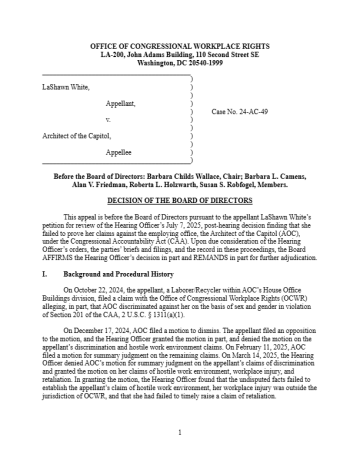
DECISION OF THE BOARD OF DIRECTORS
This appeal is before the Board of Directors pursuant to the appellant LaShawn White’s petition for review of the Hearing Officer’s July 7, 2025, post-hearing decision finding that she failed to prove her claims against the employing office, the Architect of the Capitol (AOC), under the Congressional Accountability Act (CAA). Upon due consideration of the Hearing Officer’s orders, the parties’ briefs and filings, and the record in these proceedings, the Board AFFIRMS the Hearing Officer’s decision in part and REMANDS in part for further adjudication.
I. Background and Procedural History
On October 22, 2024, the appellant, a Laborer/Recycler within AOC’s House Office Buildings division, filed a claim with the Office of Congressional Workplace Rights (OCWR) alleging, in part, that AOC discriminated against her on the basis of sex and gender in violation of Section 201 of the CAA, 2 U.S.C. § 1311(a)(1).
On December 17, 2024, AOC filed a motion to dismiss. The appellant filed an opposition to the motion, and the Hearing Officer granted the motion in part, and denied the motion on the appellant’s discrimination and hostile work environment claims. On February 11, 2025, AOC filed a motion for summary judgment on the remaining claims. On March 14, 2025, the Hearing Officer denied AOC’s motion for summary judgment on the appellant’s claims of discrimination and granted the motion on her claims of hostile work environment, workplace injury, and retaliation. In granting the motion, the Hearing Officer found that the undisputed facts failed to establish the appellant’s claim of hostile work environment, her workplace injury was outside the jurisdiction of OCWR, and that she had failed to timely raise a claim of retaliation.
A hearing was held on April 7 and 8, 2025, on the appellant’s remaining discrimination claims. After the hearing, the Hearing Officer issued a decision in favor of AOC determining that the appellant had failed to establish any of those claims. In the decision, the Hearing Officer examined whether the appellant was discriminated against when AOC: (1) issued her a Memorandum of Counseling on August 5, 2024, following her failure to report to the Longworth House Office Building as assigned; (2) issued her a Letter of Expectations on August 14, 2024, clarifying communications protocol in her chain-of-command; and (3) assigned her from the second floor to the first floor of the Cannon House Office Building, after her above assignment to Longworth was rescinded on August 14, 2024, following a grievance filed by the appellant. With respect to each of these issues, the Hearing Officer found that the appellant failed to prove that AOC’s nondiscriminatory reasons for its actions were pretext for discrimination. The Hearing Officer in the decision also readdressed and found against the appellant again on her claims of hostile work environment, workplace injury, and retaliation.
On August 6, 2025, the appellant timely filed a petition for review of the Hearing Officer’s decision challenging these findings on appeal.
II. Standard of Review
We must set aside a Hearing Officer’s decision if we determine the decision to be:
(1) arbitrary, capricious, an abuse of discretion, or otherwise not consistent with the law; (2) not made consistent with required procedures; or (3) unsupported by substantial evidence. 2 U.S.C. § 1406(c); Torres-Velez v. Office of the Architect of the Capitol, No. 17-AC-36 (FL, RP, CV), 2019 WL 10784232, at *2 (OCWR Sept. 23, 2019); Rouiller v. U.S. Capitol Police, No. 15-CP-23 (CV, AG, RP), 2017 WL 106137, at *6 (OOC Jan. 9, 2017); Hatcher v. Architect of the Capitol, No. 96-AC-15 (CV, RP), 1998 WL 35281336, at *4 (OOC Feb. 18, 1998). In making determinations under subsection (c), we review the whole record, or those parts of it cited by a party, and due account shall be taken of the rule of prejudicial error. 2 U.S.C. § 1406(d).
Substantial evidence is “such relevant evidence as a reasonable mind might accept as adequate to support a conclusion.” Biestek v. Berryhill, 139 S.Ct. 1148, 1154 (2019). A reviewing body should accept such factual findings if they are supported by the record as a whole and should not supplant those findings merely by identifying alternative findings that could be supported by that record. Arkansas v. Oklahoma, 503 U.S. 91, 113 (1992); Cobbin v. U.S. Capitol Police, No. 21-CP-10 (CV, RP), 2023 WL 8471328, at *2 (OCWR Sept. 27, 2023). The question is not whether we would have made the same decision, or whether there is a “scintilla” of evidence in the record that is contrary to the Hearing Officer’s decision. The only issue for us is whether, on the record as a whole, there is substantial evidence to support the Hearing Officer’s findings. Johnson v. Office of the Architect of the Capitol, No. 96-AC-25 (CV), 1998 WL 35281337, at *4, *10 (OOC May 22, 1998).
III. Analysis
A. The Hearing Officer’s Determination that the Appellant Failed to Establish Her Discrimination Claims is Supported by Substantial Evidence
Section 201 of the CAA governs employment discrimination claims. It provides, in relevant part that, “[a]ll personnel actions affecting covered employees shall be made free from any discrimination based on race, color, religion, sex, or national origin, within the meaning of section 703 of the Civil Rights Act of 1964 (42 U.S.C. 2002-e).” 2 U.S.C. § 1311(a)(1).
To establish a prima facie case of discrimination under the CAA, an employee must show that (1) they are a member of a protected class, (2) they suffered an adverse employment action, and (3) the action gives rise to an inference of discrimination. If the employee meets this burden of production, “[t]he burden then must shift to the [employing office] to articulate some legitimate, nondiscriminatory reason” for its action. If the office does so, then the employee must “be afforded a fair opportunity to show that [the employing office’s] stated reason…was in fact pretext” for unlawful discrimination. Torres-Velez, 2019 WL 10784232, at *5.
As an initial matter, we note that focusing on the elements of a prima facie case is misplaced in a post-hearing appeal. Where a hearing has been held and the record is complete, the inquiry shifts to whether the employee has demonstrated by a preponderance of the evidence that the employing office’s proffered reason for its actions was pretext for discrimination – a burden of proof which remains at all times with the employee. Evans v. Office of the Architect of the Capitol, No. 16-AC-18 (CV, RP), 2018 WL 4382909, at *4 (OOC Sept. 12, 2018); U.S. Postal Serv. Bd. of Governors v. Aikens, 460 U.S. 711, 715 (1983).
In this case, the Hearing Officer did not reject the appellant’s claims because she failed to establish a prima facie case of discrimination. The Hearing Officer did so because, considering the record as a whole, he found substantial evidence that the employing office had legitimate, nondiscriminatory reasons for taking the above series of actions against the appellant, and the appellant failed to show that those reasons were pretext for discrimination. Specifically, the record reflects that the Letter of Expectations was issued due to well-documented, ongoing communications issues between the appellant and her supervisors, the Memorandum of Counseling was issued due to the appellant’s repeated failure to report to Longworth as assigned, and that, following the rescission of her assignment to Longworth, the appellant was assigned to the first floor of Cannon due to operational needs and staffing shortages in the building.
On appeal, the appellant argues that AOC’s stated nondiscriminatory reasons for its actions were pretext for discrimination. In support of this contention, the appellant variously argues that the Hearing Officer ignored or overlooked certain pieces of evidence in the record.
Upon review of the record, the appellant has not met her ultimate burden of showing discrimination on the part of AOC with respect to its actions, nor has the appellant shown that the Hearing Officer’s determinations were unsupported by substantial evidence. The appellant’s arguments on appeal mainly rest on misapplied legal concepts or evidence in the record that she alleges was ignored by the Hearing Officer. However, mere disagreement with the Hearing Officer’s conclusions is not a basis for overturning a decision. Moreover, even if the Hearing Officer failed to mention every piece of record evidence cited by the appellant, we have repeatedly recognized that a Hearing Officer’s failure to do so is not a basis for granting review. George-Winkler v. Office of Congressman Robert D. (“Bobby”) Scott, Nos. 19-HS-30 (DA, FM, RP), 19-HS-74 (DA, FM, RP), 2023 WL 8788936, at *4 (OCWR Dec. 12, 2023).
In short, the appellant has not provided a sufficient basis for overturning the Hearing Officer’s determination that the Letter of Expectations, Memorandum of Counseling, and the assignment to the first floor of Cannon, were not discriminatory.
B. The Hearing Officer’s Determination that the Appellant Failed to Establish her Hostile Work Environment Claim is Supported by Substantial Evidence
To establish a hostile work environment claim, the appellant must show that she was subjected “to discriminatory intimidation, ridicule, and insult that [was] sufficiently severe or pervasive to alter the conditions of the victim’s employment and create an abusive working environment.” Pillai v. U.S. Capitol Police, No. 19-CP-27 (AG, CV, RP), 2021 WL 1963840, at *9 (OCWR May 6, 2021); Williams v. Architect of the Capitol, No. 14-AC-11 (CV, RP), 2017 WL 5635714, at *8 (OOC Nov. 21, 2017). A hostile work environment claim requires proof that the environment was objectively hostile or abusive and was subjectively perceived as such. Harris v. Forklift Sys., Inc., 510 U.S. 21-23, (1993); Baird v. Gotbaum, 792 F.3d 166, 172 (D.C. Cir. 2015) (“[T]he standard for severity and pervasiveness is an objective one.”) These standards for judging hostility are sufficiently demanding to ensure that Title VII does not become a “general civility code.” Faragher v. City of Boca Raton, 524 U.S. 775, 787 (1998).
The appellant’s hostile work environment claim was initially dismissed on summary judgment because the Hearing Officer concluded that the undisputed facts did not establish a hostile or abusive work environment. However, the appellant raised the claim again in her post-hearing brief and the Hearing Officer reconsidered the issue in the post-hearing decision. In the decision, the Hearing Officer found again – even after explicitly considering the evidence submitted at hearing – that the Letter of Expectations, Memorandum of Counseling, and the assignment in Cannon were not sufficiently severe and pervasive to create a hostile or abusive working environment. The Hearing Officer also found again that the appellant failed to demonstrate that the above actions were taken because of her sex or gender.
On appeal, the appellant fails to address the elements of a hostile work environment claim and instead reiterates arguments that she raised in support of her disparate treatment claims. As we have stated, mere disagreement with the Hearing Officer’s conclusions is not a basis for overturning a decision. Moreover, we have repeatedly rejected hostile work environment arguments based on personnel or work-related actions by supervisors. Aiken v. Library of Congress, No. 19-LC-78 (CV, FM), 2022 WL 21807824, at *9 (OCWR May 16, 2022) (citing Williams, WL 5635714, at *9) (“The work-related actions taken…were not objectively offensive, abusive, hostile, or threatening.”). Finally, an essential component of a hostile work environment claim is that it was discriminatory based on an employee’s membership in a protected class, and the appellant has failed to demonstrate that connection.
Accordingly, we find that the Hearing Officer’s decision was based on substantial evidence and find no basis for overturning the determination below.
C. The Hearing Officer’s Determination on the Appellant’s Workplace Injury was Harmless Error
As part of her discrimination claims, the appellant alleged she was injured as a result of her assignment to the first floor of the Cannon building. On summary judgment, the Hearing Officer dismissed the appellant’s assertions regarding her workplace injury as a workers’ compensation claim outside of OCWR’s jurisdiction. On appeal, the appellant argues she raised her injury not as a workers’ compensation claim, but rather as evidence in support of her disparate treatment and hostile work environment claims. The appellant argues that the Hearing Officer’s omission of such evidence during the hearing prevented her from fully demonstrating the effects of the discrimination she experienced.
A review of the appellant’s claim form, opposition to the motion to dismiss, and opposition to the motion for summary judgment indicates that she was raising her workplace injury as evidence of her claims of discrimination, and that the Hearing Officer’s characterization of the workplace injury as a workers’ compensation claim was in error. However, the conclusion that the Hearing Officer erred does not end our inquiry. We must next determine whether the erroneous omission of the evidence prejudiced the outcome of the hearing or was harmless error.
An error is harmless if it did not have a substantial and injurious effect or influence in determining the outcome of the case. United States v. Powell, 334 F.3d 42, 45 (D.C. Cir. 2003) (citing Kotteakos v. United States, 328 U.S. 750, 776, 66 S.Ct. 1239, 1253, 90 L.Ed. 1557 (1946)). When an error plainly had no bearing on the substance of its decision, we do not grant a petition for review based on that mistake. Prohibition Juice Co. v. FDA, 45 F.4th 8, 24 (D.C. Cir. 2022). The party challenging the agency’s determination generally bears the burden of showing that an error was harmful. Shinseki v. Sanders, 556 U.S. 396, 409 (2009).
Having considered the record below, the appellant has not shown that consideration of her workplace injury would have substantially influenced the outcome of the Hearing Officer’s decision. In both disparate treatment and harassment cases, the ultimate burden of proof rests on the employee to demonstrate that the alleged actions were discriminatory based on the employee’s protected class. Even if the appellant had been able to include additional evidence of the difficulty of her work assignments, such evidence would not have established that any disparity in her duties was because of her sex or gender. Indeed, the Hearing Officer in the decision fully acknowledged that the appellant’s duties were physically demanding. Rather, the Hearing Officer, after thoroughly considering and comparing the duties of the employees on the first floor, concluded there was no substantial evidence the appellant was subjected to discrimination in her assignment based on her sex or gender.
Because the appellant has not met her burden of showing that prejudice occurred as a result of the error, nor have we found in our own review of the record that prejudice occurred, the Hearing Officer’s error in disallowing evidence of the appellant’s workplace injury was harmless. Accordingly, it provides no basis for overturning the determination below.1
D. The Hearing Officer’s Ruling on Evidentiary Matters was Not an Abuse of Discretion
During the conclusion of the hearing, the Hearing Officer stated, “[AOC] wants to check whether one document was previously submitted as part of the motion for summary judgment exhibits. If it has not been admitted into evidence already, I am giving [AOC] until the end of this week…to submit this document, which would then be marked as Agency Exhibit 26, and of course it will be provided to [the appellant].” Tr. at 375. The appellant argues on appeal that the Hearing Officer impermissibly allowed AOC to introduce this exhibit after the close of the hearing in violation of OCWR Procedural Rules §§ 7.14 and 7.15(b).
Evidentiary rulings are reviewed under an abuse of discretion standard. Muldrow ex rel. Estate of Muldrow v. Re-Direct, Inc., 493 F.3d 160, 166 (D.C. Cir. 2007); United States v. Harper, 118 F.4th 1288, 1296 (10th Cir. 2024) (“Evidentiary rulings ‘may constitute an abuse of discretion only if based on an erroneous conclusion of law, a clearly erroneous finding of fact or a manifest error in judgment.’”). A plain reading of the procedural rules demonstrates that the appellant’s reading of the rules is incorrect. While Rule § 7.15(b) addresses evidence submitted after the closure of the hearing record, Rule § 7.15(a) states that, “… the Merits Hearing Officer may hold the record open as necessary to allow the parties to submit arguments, briefs, documents, or additional evidence previously identified for introduction.” In contrast, Rule § 7.14 merely states that, “The Merits Hearing Officer may require the parties to file proposed findings of fact and conclusions of law and/or posthearing briefs on the factual and the legal issues presented…”
The Hearing Officer’s evidentiary ruling during the hearing fell squarely within the parameters of the procedural rules. Additionally, to any extent that the Hearing Officer may have erred in admitting the exhibit in question, there is no indication that the ultimate conclusions in the decision relied in any significant part on the contents of the exhibit. See Dines v. Library of Congress, No. 23-LC-44 (CV, DA, FM, RP), 2025 WL 1019270, at *1 n.2 (OCWR Mar. 26, 2025) (finding that any error by the Hearing Officer was harmless because the appellant’s claims were dismissed on other grounds); see also Harper, 118 F.4th at 1296 (“Even if the court finds an erroneous evidentiary ruling, a new trial will be ordered ‘only if the error prejudicially affects a substantial right of a party.’”). In sum, the appellant provides no basis on appeal for the Board to disturb the Hearing Officer’s evidentiary rulings during the hearing.
E. The Appellant’s Retaliation Claim is Entitled to Further Consideration
The appellant, who is pro se and not an attorney, checked the boxes on the claim form for sex discrimination and hostile work environment. She did not check the box for “Unlawful Reprisal,” which asked whether she “suffered an adverse employment action because [she] opposed a practice made unlawful by the CAA [or] initiated proceedings, made a charge, or testified, assisted, or participated in a hearing or other proceeding under the CAA.” She did, however, check the box which asked whether a senior staff member of the House or Senate “personally intimidated, retaliated, or discriminated against you because you raised a claim of harassment.” (emphasis added). The appellant then listed the names of several AOC supervisors underneath that box. While the appellant may have misunderstood the legal terminology on the claim form and/or the technical definition of a “senior staff” member, she did check a box which asked whether she was alleging that she was “intimidated, retaliated, or discriminated against” and identified by name the individuals she believe engaged in such conduct. In her attachment to her claim form, the appellant focused on her reassignment to the Longworth building and the concerns she raised that she felt unsafe working in that building because an employee who had allegedly harassed her and others worked there. In a subsequent email addendum to her claim form, the appellant also complained about being assigned to a more physically difficult assignment and not receiving help with laborious tasks – presumably related to her assignment to the Cannon building after the reassignment to Longworth was rescinded. Although she did not use the words “reprisal” or “retaliation” in her email addendum, she mentioned having previously complained about safety concerns.
AOC moved to dismiss. Although AOC did not seek dismissal of any retaliation claims in its motion, the appellant raised more specific allegations of retaliation in her opposition to the motion to dismiss, this time specifically using the word “retaliation.” She alleged that, following her complaints about being assigned to work in the Longworth building near an alleged sexual harasser, she was assigned to more difficult job duties in the Cannon building, denied requests for assistance with physically difficult tasks and, as a result, was injured on the job. In discussing the assignment back to Cannon, she alleged that “[m]anagement has participated in discriminatory acts of retaliation against the Claimant for speaking against disparity in the workplace and has given way to a chain reaction of setbacks and a hostile workplace.” Opposition to Motion to Dismiss at 10. The Hearing Officer did not address any retaliation allegations in his decision on the motion to dismiss and his summary of the remaining claims did not mention retaliation.
AOC subsequently moved for summary judgment. That motion did not address any retaliation claims. In her opposition to the summary judgment motion, the appellant provided additional details related to retaliation. She stated that she “engaged in protected activity of opposing sexual harassment” and was then subjected to a series of retaliatory actions including a negative performance evaluation, the Letter of Expectations, the Memorandum of Counseling, and ultimately an assignment to a more physically demanding assignment in the Cannon building where she was not provided any assistance with laborious tasks. In its reply, AOC argued that the appellant failed to check the “reprisal” box on her claim form and, although she checked the box indicating that she was “intimidated, retaliated, or discriminated against” by a senior staff member, she failed to allege any facts supporting that claim.
In his ruling on the summary judgment motion, the Hearing Officer dismissed the appellant’s retaliation claim on the grounds that she failed to raise it in her claim form or the attachment to her claim form, failed to amend her claim to include retaliation, and failed to present any evidence that a senior staff member of the House or Senate was involved. After the appellant attempted to litigate the issue at hearing, the Hearing Officer reiterated his ruling on summary judgment in the post-hearing decision. On appeal, the appellant argues she sufficiently raised her retaliation claim throughout the proceedings below and any failure to raise such claim was a “technical error.”
Decisions on summary judgment are reviewed de novo. Leggett v. Library of Congress, No. 20-LC-18 (CV), 2021 WL 4424091, at **3-4 (OCWR Sept. 20, 2021). It is well settled that claims cannot be raised for the first time in response to a motion for summary judgment. Cutrera v. Bd. of Supervisors, 429 F.3d 108, 114 (5th Cir. 2005) (“A claim which is not raised in the complaint but, rather, is raised only in response to a motion for summary judgment is not properly before the Court.”). Nor, as we have ruled in the past, can a claimant amend their pleadings by way of an opposition to a motion to dismiss. Brown and The Office of the Chief Administrative Officer of the U.S. House of Representatives, No. 24-HS-27 (DA, RP), 2025 WL 4687014, at *4 (OCWR Sept. 30, 2025).
Nevertheless, in Brown, we made clear that pro se claimants are held to less stringent pleading requirements, and claims may proceed where the claimant has alleged enough to put the employer on notice. 2025 WL 4687014, at *3 (OCWR Sept. 30, 2025) (citing Gormley v. U.S. Capitol Police Board, No. 07-CP-35 (DA), 2008 WL 5476090, at *5 (OOC Aug. 7, 2008) (“administrative employment discrimination pleadings under the CAA need only give fair notice of the claims and grounds upon which they rest”)). Moreover, pro se claimants may supplement or clarify an allegation in their initial claim form with additional facts in an opposition to a motion to dismiss. See Naz v. Wright, 177 F.4th 1242, 1249 (D.C. Cir. 2026); Spence v. U.S. Dep’t of Veterans Affairs, 109 F.4th 531, 538 (D.C. Cir. 2024). Hearing officers generally must consider a pro se claimant’s claim “in light of” all filings. Brown v. Whole Foods Mkt. Grp., Inc., 789 F.3d 146, 152 (D.C. Cir. 2015) (reversing district court’s dismissal of discrimination claim where it failed to consider additional facts asserted by a pro se claimant in his opposition to a motion to dismiss). When weighing whether a pro se claimant has stated a claim, hearing officers must treat technical deficiencies in the claim form leniently and scrutinize the claim form and the claimant’s opposition to a motion to dismiss to determine if any legally cognizable claim has been alleged. Spence, 109 F.4th at 538.
Although the appellant’s filings are difficult to decipher, we find that she asserted enough facts in her claim form and addendum and in her opposition to the motion to dismiss to have raised a claim of retaliation prior to the summary judgment stage. In doing so, we disclaim any suggestion that a hearing officer must “cull through every filing of a pro se litigant to preserve a defective complaint.” Naz, 177 F.4th at 1248. Hearing officers retain discretion to manage their cases and apply the procedural rules governing party submissions in a manner consistent with the obligation to give appropriate leeway to pro se parties. Id. We merely hold, as we have held in previous cases, that decisions on the merits should not be avoided on the basis of mere technicalities. See Brown, 2025 WL 4687014, at *4.
Section 208 of the CAA governs retaliation claims. It states that, “[i]t shall be unlawful for an employing office to intimidate, take reprisal against, or otherwise discriminate against, any covered employee because the covered employee has opposed any practice made unlawful by this chapter…” 2 U.S.C. § 1317(a). A claimant’s opposition to practices unlawful under the CAA must only be based on a “reasonable and good faith belief that the opposed practices were unlawful.” Johnson v. University of Cincinnati, 215 F.3d 561, 579 (6th Cir. 2000). While there is some overlap in that the appellant asserts that the same actions by AOC were both discriminatory and retaliatory, the analysis of a retaliation claim is necessarily different from an analysis of other claims of discrimination. A hearing officer, when analyzing a retaliation claim, may place different weight on certain factors than when analyzing a disparate treatment claim, as each claim presents a distinct causal question – one asks whether a protected characteristic drove the employment action, while the other asks whether a prior protected activity did. As a result, the identical legitimate, nondiscriminatory reason given by the employing office for a particular action may suffice under one claim while failing as pretext under another. See Lyles v. District of Columbia, 65 F.Supp.3d 181, 193 (D.D.C. 2014) (finding that “because of the differing elements of a claim for retaliation and discrimination, it was possible for the Court to find the same nondiscriminatory reason to be pretextual in the context of one but not the other.”).
Because of this, and mindful of the fact that we are a body of review, not first view, we find that the Hearing Officer is in the best position to assess and rule on the merits of the appellant’s retaliation claim in the first instance. See Anderson v. City of Bessemer, 470 U.S. 564, 674 (1985); see also Cutter v. Wilkinson, 544 U.S. 709, 718 n.7 (2005). We note, however, that the record indicates that the appellant regarded her retaliation claim as pending before the Hearing Officer through the entirety of the discovery phase of the proceedings below. Accordingly, on remand, the Hearing Officer should first determine whether the existing record is sufficiently developed to evaluate the retaliation claim, or whether further discovery is appropriate.2
We therefore vacate the dismissal of the retaliation claim and remand the claim for further review.
ORDER
For the foregoing reasons, the Board AFFIRMS in part and REMANDS in part the Hearing Officer’s decision on the appellant’s claims.
It is so ORDERED.
Issued, Washington, D.C., September 11, 2026
1 We note that in assessing the appellant’s disparate treatment claims, the Hearing Officer cited to older precedent to find that she did not suffer an adverse action. Because the Hearing Officer’s ultimate determinations did not rely on a finding of adverse action, but rather on failure to prove pretext for discrimination, any error that occurred is also harmless. Nonetheless, we clarify that the standard in assessing adverse actions is whether an employee experienced “some harm” with respect to a term or condition of their employment. Muldrow v. City of St. Louis, 144 S.Ct. 967, 972 (2024).
2 The Hearing Officer in the post-hearing decision also rejected the appellant’s retaliation claim based on a negative performance evaluation she received allegedly because she engaged in protected activity, finding that the appellant failed to raise the issue of her performance evaluation in her claim form. A review of the record indicates that the appellant raised her performance evaluation for the first time in her opposition to AOC’s motion for summary judgment. As stated above, claims cannot be raised for the first time in response to a motion for summary judgment. Accordingly, the performance evaluation may not be considered as a standalone claim on remand. The Hearing Officer may, however, consider the performance evaluation, as with any other record evidence, as background evidence in support of the appellant’s retaliation claim.